Posts

Job Posting: Social Science Research Analyst, Office of Inspector General - U.S. Department of Health & Human Services - Region 7, Kansas City

About the Office of Inspector General - Since its 1976 establishment, OIG has been at the forefront of the Nation's efforts to fight waste, fraud and abuse in Medicare, Medicaid and more than 100 other HHS programs. HHS OIG is the largest inspector general's office in the Federal Government, with approximately 1,600 dedicated to combating fraud, waste and abuse and to improving the efficiency of HHS programs. A majority of OIG's resources goes toward the oversight of Medicare and Medicaid — programs that represent a significant part of the Federal budget and that affect this country's most vulnerable citizens. OIG's oversight extends to programs under other HHS institutions, including the Centers for Disease Control and Prevention, National Institutes of Health, and the Food and Drug Administration. We carry out our mission using a multidisciplinary, collaborative approach, with each of our six components playing a vital role. A nationwide network of a...
Careers Outside the Academy

Image
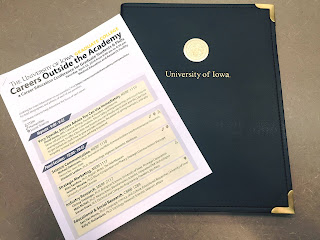
By: Erin Mobley The Graduate College hosted Careers Outside the Academy : a Career Education Conference for Masters and Ph.D. students on Saturday, April 23, at the Medical Education and Research Facility on campus. This event was the first of its kind for graduate students at the University of Iowa. Students were able to hear from speakers who successfully made the transition from graduate school to careers outside of academics (a.k.a., the academy), network with attendees and fellow students, and share ideas and experiences to learn from each other. I attended, along with fellow Ph.D. student, Jure Baloh. The day kicked off with an inspiring keynote address from David Sarco, founder of Lighthaus Inc , who discussed “bite-sized” techniques and lessons to use in both your professional and personal life. Most interesting was the discussion around empathy, using the Bad Day Principle. The idea behind this is that if you take a step outside of what’s going on in your head, you would...

Job Opportunity: TA, University of Iowa, Iowa City, IA

Description Requirements Info about organization Where to apply:

Student Poster Presentation - University of Iowa QI Symposium

Image
By: Jordan Brelje On Wednesday, April 6, a group of University of Iowa MHA students presented their poster, “A real-time, customizable, Hazard Vulnerability Analysis tool for use during Hospital Incident Command System activations,” at the fourth annual University of Iowa Quality Improvement Symposium. The poster described a semester-long project that the students (Jordan Brelje, Aaron Horsfield, Anna Saxon and Cory Stetson) have been working on as part of a Hospital Organization and Management course. Students enrolled in the course have the opportunity to engage in meaningful consulting projects for the University of Iowa Hospitals and Clinics (UIHC). The team’s project came about after the need for a real-time hazard analysis tool became evident during a recent hospital incident command system (HICS) exercise. In addressing this need, the team developed an Excel-based tool which allows users to compare the institutional threat of multiple hazards in real time. The real-time...

MHA Class Trip Spring 2016

Image
By: Kaitlyn Hunsberger The first year MHA class had the opportunity to visit two dynamic health care organizations in Iowa for our spring class trip. We started our day at Waverly Health Center (WHS), a 25-bed critical access hospital (CAH) in Waverly, Iowa with Jim Atty, CEO and 2009 MHA Iowa alum. The morning was filled with discussion surrounding the unique issues that critical access hospital face and the importance of an organizational philanthropy program. One of the most intriguing obstacles that critical access hospitals will face in the next couple of decades is the transition from volume to value. Inherently, critical access hospitals are paid in a fee-for-service model. So the larger question becomes: How will critical access hospitals manage this shift when they seemingly do not have a place in the shift?   Mr. Atty was unable to answer this question and confirmed that healthcare leaders are also unsure of how CAHs will navigate this shift. Emily Neuendorf, the WHC...

University of Iowa Quality Improvement Symposium Poster Presentation

Image
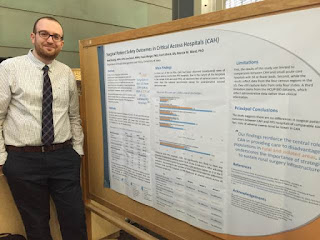
By: Nabil Natafgi PhD student, Nabil Natafgi, recently presented a poster at the fourth annual University of Iowa Quality Improvement Symposium. Background information and findings of the study presented in the poster are as  follows : Surgical Patient Safety Outcomes in Critical Access Hospitals: How Do They Compare? Nabil Natafgi, MPH; Jure Baloh, MHA; Paula Weigel, PhD; Fred Ullrich ,BS; Marcia M. Ward, PhD Research Objective: Critical Access Hospital (CAH) are the predominant type of hospitals operating in small and isolated rural areas, constituting approximately 27% of all community hospitals in the US. The intent of CAH designation is to reduce financial vulnerability of rural hospitals by providing a payment system based on cost, as opposed to prospective payment system (PPS) – the predominant  reimbursement model for larger urban-centered hospitals. Such financial incentives are believed to  improve access to healthcare by keeping ...

ACHE Congress 2016

Image
By: Tyler Bennett The University of Iowa’s Master of Health Administration candidates recently attended the 2016 American College of Healthcare Executives (ACHE) Congress on Healthcare Leadership in Chicago. This year’s theme was “Leading Well” and was held at the Hyatt Regency Chicago from March 14-17. As student members, we were able to attend speed networking events where we had the opportunity to meet students from other healthcare programs, as well as other ACHE members. In addition to networking opportunities, Congress also offered a lot of intriguing information about hot topics in the healthcare field, along with what health systems are doing to better position their organizations moving forward. One of the seminars that we were able to attend focused on the fellowship application process as we transition to the new National Council of Administrative Fellowships (NCAF) application, which hopes to standardize the application process. Additional session topics included ...